Best Policy as Code Tools for 2026
Compare the best policy as code tools for 2026, including OPA, Sentinel, Spacelift, Checkov, and EnvManager for secure DevOps governance.
Policy as code tools can block risky changes before they reach production. But policy enforcement is only part of the job. Your team also needs control over secrets, access, evidence, and the systems already in your delivery path.
Here are five strong options, with EnvManager first for teams that need secure environment policy control, followed by tools built for infrastructure governance and CI/CD checks.
1. EnvManager, Secure Environment Policy Control
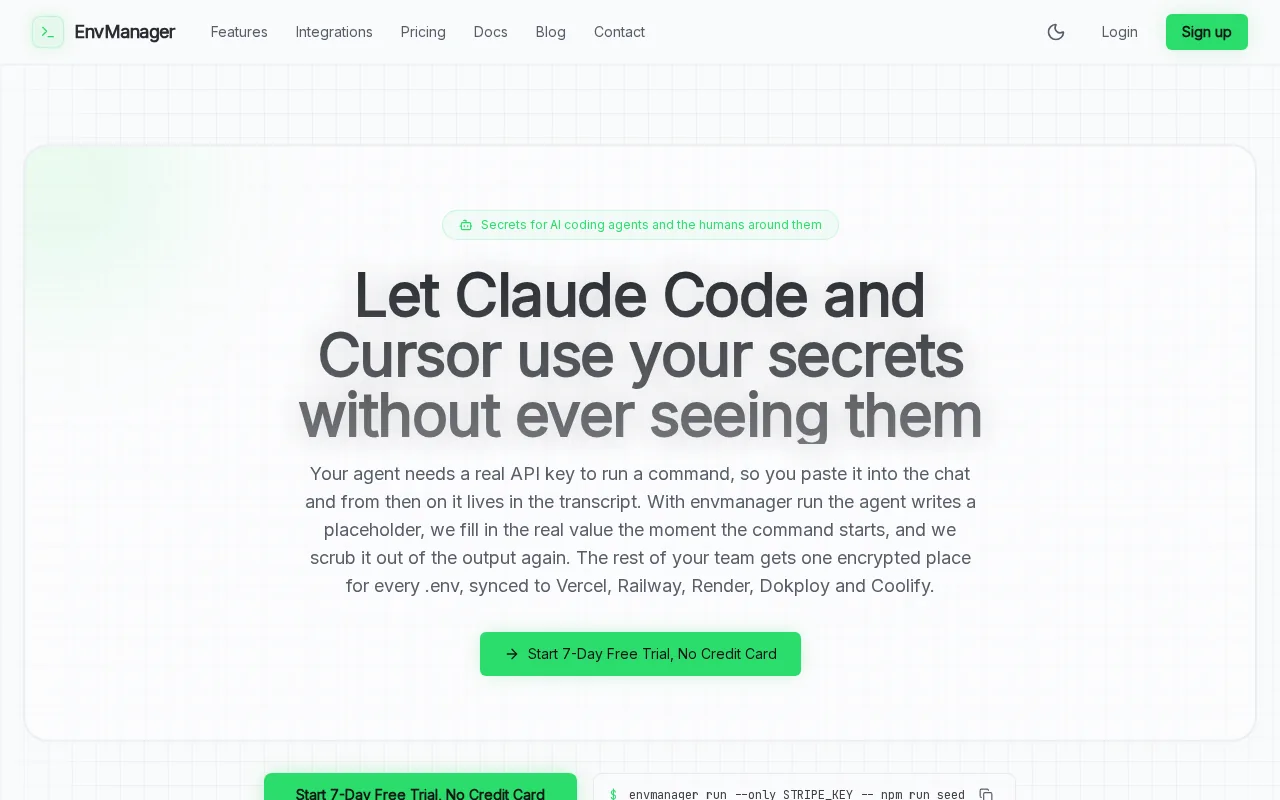
EnvManager is a self-serve SaaS platform for managing encrypted.envfiles across developer workstations and CI/CD pipelines.
Best for: DevOps teams, SaaS developers, engineering leads, and security staff who need one controlled place for environment secrets.
We encrypt every value with AES-256 on import. EnvManager also keeps environment files under version control, so your team can see what changed and when. Role-based access control, or RBAC, limits access by user role instead of relying on shared files.
That matters when a developer needs a local database key but should not see production credentials. It also helps when a CI job needs a small set of secrets for one deploy. You can sync approved values to local machines or delivery pipelines without passing them through chat, email, or shared documents.
Secrets management is wider than password storage. It covers programmatic credentials such as API keys, tokens, certificates, and database credentials. Credentials can hide in source code, container images, logs, pipeline files, and developer workstations.
EnvManager fits the environment-file part of that problem. It should not be treated as a full policy engine for Kubernetes admission or Terraform plans. Its value is tighter control over the secrets that developers and pipelines already use every day.
If leaked.envfiles are your weak point, start by moving one shared environment into EnvManager. Then set access rules before adding more teams.
2. Open Policy Agent (OPA), Flexible General-Purpose Policy Enforcement
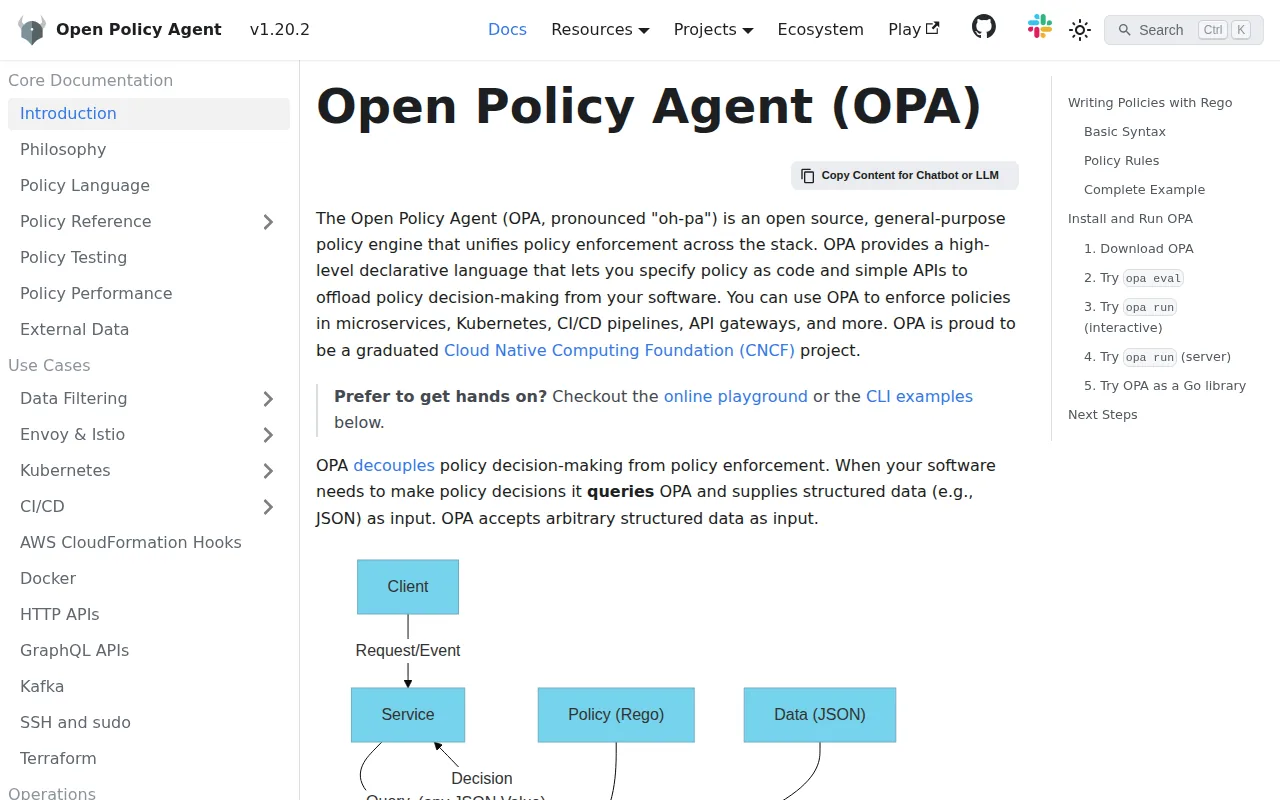
Open Policy Agent is a general-purpose policy engine for teams that need the same decision logic across several systems.
Best for: Platform teams that want policy decisions outside application code.
OPA uses Rego, its policy language, to evaluate structured input. An application, API gateway, Kubernetes admission flow, or CI job sends data to OPA. OPA returns a decision that the calling system can enforce.
That design helps when one rule must work in more than one place. For example, a team could check a Terraform plan before deployment, then apply related access rules at an API gateway. The rule lives separately from each application, so a policy change does not always require a full application release.
OPA also supports several operating models. You can run it as a standalone service, embed it with a Go application, or use it as a Kubernetes sidecar.
Decision logging is another strong point. OPA documents audit trails for policy decisions, which can include the query, result, timestamp, decision ID, and bundle details. That evidence helps during access reviews or when an engineer needs to explain why a deployment was blocked.
The tradeoff is ownership. Rego is flexible, but your team must write, test, review, and maintain the rules. OPA gives you an engine. It does not decide which internal controls your company should enforce.
Choose OPA when policy must cross system boundaries. Choose EnvManager when the immediate issue is secure control of environment secrets.
3. Sentinel, Terraform-Centered Policy as Code
Sentinel is a policy language and enforcement system built for Terraform Cloud and Terraform Enterprise workflows.
Best for: Organizations that already run Terraform and want checks between the plan and apply stages.
Sentinel can check whether an infrastructure plan follows internal rules before Terraform provisions resources. A policy might require tags, limit allowed instance types, or reject a change that violates a security requirement.
Sentinel supports several enforcement outcomes. A rule can warn while allowing a run to continue. It can require approval from an administrator. It can also stop the run until the configuration passes.
That range helps teams introduce governance without blocking every developer on day one. Start with advisory checks for low-risk rules. Move strict controls into blocking mode once the team understands the failure messages and exception process.
Sentinel is also designed for shared review. Operations, security, finance, and compliance staff can contribute requirements without writing application code. Version-controlled policies give reviewers a clearer record than a long document that someone must remember during every ticket review.
Its limit is scope. Sentinel makes the most sense when Terraform is the center of your infrastructure workflow. If your estate uses several policy engines or mixes many deployment systems, OPA may give you a wider base.
For teams building evidence for internal controls, pair deployment checks with a separate secrets workflow. EnvManager can cover the environment values that Terraform policies do not manage.
4. Spacelift, Governance Across Multi-Tool Infrastructure Workflows
Spacelift is an infrastructure workflow platform that applies governance across more than one infrastructure tool.
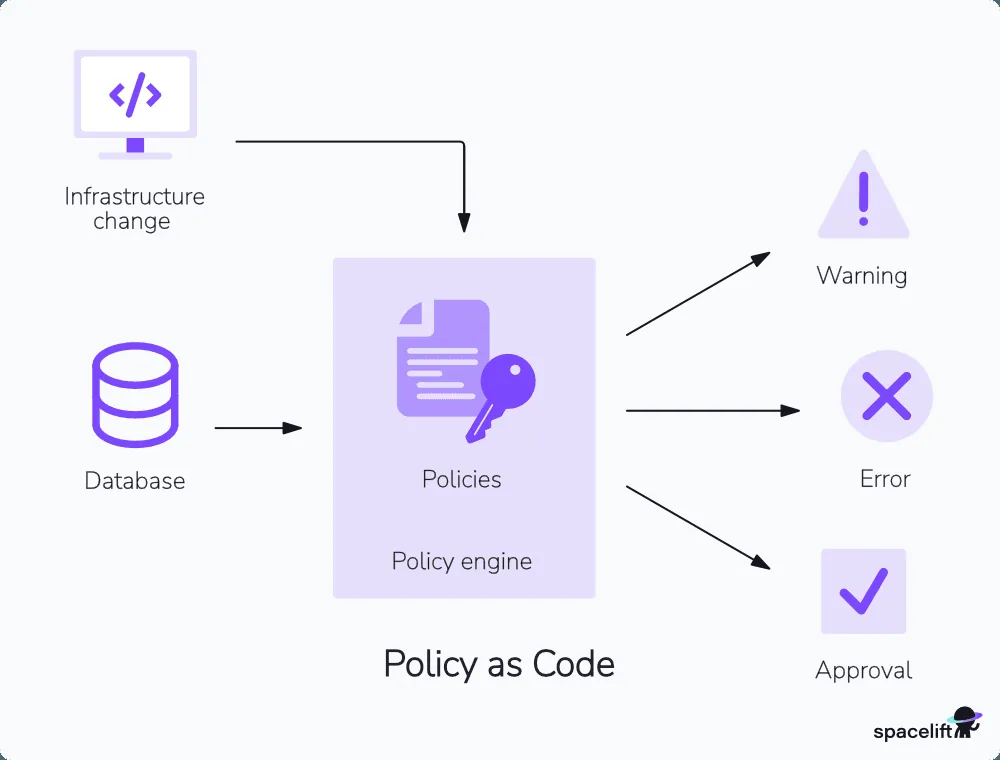
Best for: Teams that run Terraform, OpenTofu, or Pulumi and want one workflow layer for policy checks and deployment control.
Spacelift is documented with integrations for Terraform, OpenTofu, and Pulumi. That makes it useful when a company has more than one infrastructure stack and does not want every team to build its own approval path.
Governance can sit inside the run process. A proposed change can face policy checks before resources are applied. The platform also supports dynamic, short-lived credentials, which can reduce reliance on credentials that stay valid for long periods.
Audit visibility deserves a close look here.
That focus is important because automation alone does not prove control. A blocked run tells you that a rule fired. An audit trail helps answer who changed the input, what decision followed, and what happened next.
The caveat is platform fit. Spacelift adds a workflow layer, so teams should map its controls against existing CI/CD jobs before rollout. It may be more than you need if one Terraform workspace already has a simple, stable process.
Use Spacelift when your main problem is shared infrastructure governance across tools. Keep secret storage and environment access as a separate design decision.
5. Checkov, CI/CD Security Checks for Infrastructure as Code
Checkov is an infrastructure-as-code scanner that runs security checks during development and CI/CD.
Best for: Teams that need pre-deployment checks across several infrastructure formats.
Checkov integrates with Terraform, CloudFormation, Kubernetes, and Helm. That coverage lets one security check fit into a pipeline that contains more than one kind of infrastructure file.
Its main job is static analysis. Checkov reads infrastructure definitions and looks for policy failures before deployment. A pipeline can then report the finding or fail the build, based on the team’s rules.
This makes Checkov a good first gate for common errors. Think of a public resource, an overly broad permission, or a missing security setting. The check runs before the change reaches a live environment, when fixing the file is usually cheaper.
Custom checks are another reason teams choose it. Checkov also supports CI/CD integration, so the scan can run as part of the same workflow developers already use.
Checkov is not a secrets manager. It can help find exposed values in some code paths, but it does not replace controlled storage, access rules, or secret delivery. Teams should also decide how to handle exceptions so developers do not learn to ignore every failed check.
Pick Checkov when your main risk is insecure infrastructure configuration entering a build. Pick EnvManager when your main risk is uncontrolled environment values moving between people, machines, and pipelines.
Policy as Code Tools Compared
The right choice depends on where a rule must run. A secret access rule, a Terraform plan check, and a Kubernetes admission rule may all support security, but they do not belong in the same control point.
Use this view to narrow the shortlist before you test a tool with one live workflow. Teams that want a broader DevSecOps stack can also review these DevSecOps tools for secure delivery alongside policy controls.
| Tool | Primary control point | Best fit | Strength | Watch closely |
|---|---|---|---|---|
| EnvManager | Environment secrets and configuration | Developer teams and CI/CD owners | Encrypted, version-controlled.envfiles with RBAC | It is not a general infrastructure policy engine |
| Open Policy Agent | Applications, APIs, Kubernetes, and pipelines | Platform teams with cross-system rules | Rego-based decisions and documented audit trails | Your team owns policy design and maintenance |
| Sentinel | Terraform plan and apply workflow | Terraform Cloud or Enterprise users | Policy checks with advisory or blocking outcomes | Its strongest fit is the Terraform ecosystem |
| Spacelift | Infrastructure workflow orchestration | Mixed Terraform, OpenTofu, or Pulumi estates | Governance, short-lived credentials, drift detection, and audit trails | It adds another workflow layer to operate |
| Checkov | Static IaC scans in CI/CD | Teams scanning several infrastructure formats | Checks for Terraform, CloudFormation, Kubernetes, and Helm | A scan does not manage secrets or live access |
Audit evidence should be a specific buying question. Ask what gets recorded, how long records remain available, who can view them, and whether you can export them for a review. Teams evaluating compliance automation tools should not assume that a tool with policy automation also gives them the evidence their auditor needs.
Integration fit matters just as much. A policy that runs outside the developer’s normal workflow may be bypassed or treated as an afterthought. Test the failure path, not only the successful deployment.
For teams with scattered configuration files, start with the control that removes the most manual sharing. That often means securing environment secrets before adding more deployment gates.
FAQ
What are policy as code tools?
Policy as code tools turn operational rules into machine-readable checks. They can review an infrastructure plan, authorize an API request, scan a configuration file, or block a pipeline. The key difference is enforcement at a repeatable control point instead of relying on someone to remember a document during review.
Which policy as code tool is best for secrets?
EnvManager is a strong fit in this shortlist for teams managing environment secrets. It encrypts and version-controls.envfiles, applies RBAC, and syncs approved values to local machines or CI/CD pipelines. OPA, Sentinel, Spacelift, and Checkov focus more on policy decisions or infrastructure workflows.
Is OPA better than Sentinel?
OPA is usually the better fit when one policy must work across applications, APIs, Kubernetes, and pipelines. Sentinel is usually the better fit for Terraform-centered workflows, especially when checks belong between plan and apply. Compare the system where the rule must run, not just the policy language.
Can Checkov replace a secrets manager?
Checkov cannot replace a secrets manager. It scans infrastructure code for security problems before deployment, while a secrets manager controls storage, access, and delivery of credentials. A strong pipeline may use Checkov for IaC checks and EnvManager for encrypted environment values that developers and CI jobs need.
Do policy as code tools provide audit logs?
Some policy as code tools provide audit records, but you should verify the exact fields and retention rules. OPA documents audit trails for policy decisions, while Spacelift is described with drift detection and audit trails. A tool that blocks a change may still lack the evidence needed for access reviews or compliance work.
Conclusion
Choose EnvManager first if your urgent gap is shared or exposed environment secrets. Move one team’s.envworkflow into controlled storage, set RBAC, and connect the approved values to CI/CD. Then add OPA, Sentinel, Spacelift, or Checkov where your infrastructure workflow needs a policy gate.