
Best Compliance Automation Tools for 2026
Compare the best compliance automation tools for 2026, with features, integrations, audit workflows, and best-fit use cases for growing teams.
Most compliance automation tools track controls and collect evidence. Far fewer show who changed a secret, what changed, and when. Here are five named options, with EnvManager first for teams that need secure secret workflows plus an immutable audit trail.
1. EnvManager
EnvManager is a self-serve platform for encrypted, version-controlled environment files and secret workflows. It's best for DevOps teams that need developers to work quickly without losing control of .env values.
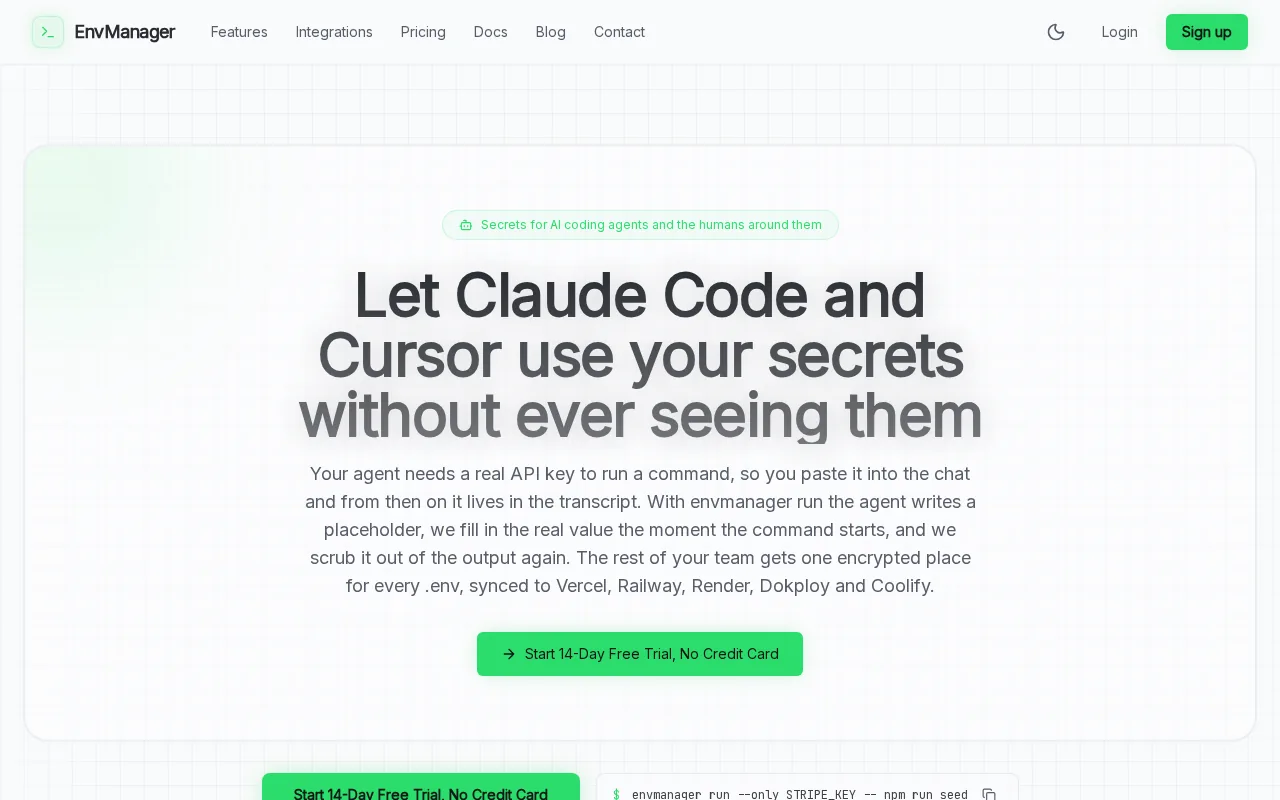
We encrypt every value with AES-256 on import. Role-based access control, or RBAC, limits who can view or change secrets. Every secret change is versioned with an immutable audit trail. That gives your security team a record that cannot be quietly rewritten after the fact.
EnvManager also syncs secrets to local machines and CI/CD pipelines. A developer can pull the right values instead of copying them through chat or storing them in a repository. A release job can receive the needed variables without exposing a full .env file to every person on the team.
That distinction matters when you compare secret management with wider compliance monitoring. A compliance dashboard may show that a control passed. EnvManager can show the edit history behind a secret, which is the evidence reviewers often need during an incident or audit.
EnvManager explicitly describes immutable, versioned logging for every secret change.
The trade-off is scope. EnvManager focuses on secrets and environment variables. It isn't a full enterprise GRC suite for mapping every policy across finance, HR, vendors, and physical assets. If your main pain is secret exposure in development, that focused scope is a strength.
Run envmanager pull when you need a clean, controlled handoff into a local or build environment. Teams comparing adjacent products can also review these environment variable management tools by workflow, access control, and audit needs.
2. Apptega Platform: Broad framework mapping and evidence automation
Apptega Platform is a security and compliance platform built around framework mapping, evidence collection, risk management, and audit work. It's best for service providers or in-house teams managing several programs at once.

Apptega states that its platform includes more than 30 frameworks. Its framework list includes CMMC, NIST CSF, SOC 2, PCI DSS, HIPAA, and ISO 27001. Cross-mapping lets one control support more than one framework, which can cut duplicate evidence work.
The platform also supports multi-tenant views. That matters to managed service providers and consultants who need separate client environments without building a separate compliance process for each account. Teams can assign tasks, collect evidence, work with auditors, and generate reports in one system.
Its automation focus is broad. Apptega describes automated evidence collection, tasking, framework mapping, vendor risk questionnaires, and documentation. It also lists integrations with tools such as Microsoft, cloud environments, HR platforms, and security tools.
Picture a company preparing for SOC 2 while also answering customer questionnaires. A shared control library can reduce repeated work. Evidence collected for one control may support several mapped requirements, while the owner sees the remaining gaps in a dashboard.
The caveat is focus. It may complement a secret manager rather than replace one.
Pick Apptega when framework breadth and client delivery matter more than developer-first environment management. Keep a separate control for secret history if that evidence is part of your audit scope.
3. Sprinto: Real-time monitoring for audit readiness
Sprinto is a compliance and trust platform that monitors controls continuously and acts on gaps. It's best for growing teams that need SOC 2, ISO 27001, HIPAA, or related programs without running every audit task by hand.

Sprinto connects to cloud, identity, HR, and SaaS systems. Its stated workflow detects changes, assesses risk, refreshes evidence, and routes approvals. That helps a small security team keep an active view of compliance rather than waiting for an annual audit.
The platform also covers vendor risk, AI governance, risk management, and security questionnaires. Sprinto says it can translate frameworks, regulations, contracts, and internal policies into machine-readable controls. That approach is useful when your obligations keep changing and several teams own different controls.
Imagine a cloud setting drifts after a deployment. A continuous monitoring platform can flag the issue while the change is still fresh. The owner can then fix the setting, attach the new evidence, and keep the control status current.
If secret history is a requirement, verify that point in a product test.
Sprinto fits teams that need continuous control monitoring. It is less clearly suited as the only system for managing developer secrets.
4. Vanta: Continuous security control monitoring
Vanta is a compliance, risk, and proof platform with continuous monitoring. It's best for startups and growing companies that need audit preparation, security questionnaires, and control visibility in one place.
Vanta describes integrations that collect security evidence and flag issues as conditions change. Its platform also covers vendor risk, audit preparation, trust center content, and questionnaire work. That combination can help a small security team respond to customer requests without rebuilding the same answer each time.
For example, a sales team may need proof of current security controls before a deal moves forward. A compliance owner can use the platform's current posture and questionnaire workflows instead of searching through old spreadsheets. The benefit comes from keeping evidence tied to control status.
Vanta also positions its agent around tasks such as drafting policies, completing questionnaires, and calling out issues. Those functions can reduce routine work, but they still need ownership. Someone must review a draft, confirm that the evidence fits the control, and fix the underlying issue.
It does not state that the product records every secret change in an immutable audit trail. It also does not provide the level of secret-specific RBAC detail described for EnvManager.
Choose Vanta when customer trust workflows and security compliance sit at the center of your buying need. Pair it with a dedicated secret workflow when developers need controlled .env access and detailed edit history.
5. Drata: Automated evidence and risk assessment workflows
Drata is a compliance platform for automated evidence collection, control testing, framework mapping, and risk workflows. It's best for teams that need one workspace for evidence, control owners, auditors, and several standards.

Drata states that teams can connect more than 300 integrated tools or use an API for evidence collection. It supports more than 30 standard frameworks and lets enterprise users create custom frameworks. Shared controls can be mapped once and reused across standards.
That model helps when the same access review supports several obligations. Instead of asking an engineer for the same screenshot three times, the compliance owner links the evidence to the shared control. The platform then keeps the control status and related evidence in one place.
Drata automates evidence collection and risk assessment workflows.
Here is a quick way to compare the five options by the problem they solve first:
| Tool | Best starting use | Strongest fit | Check before buying |
|---|---|---|---|
| EnvManager | Secret and .env control | Developer workflows, CI/CD, immutable change history | Broader GRC coverage |
| Apptega Platform | Framework and client program management | Multi-framework and multi-tenant compliance | Secret-specific audit logging |
| Sprinto | Continuous control monitoring | Live posture, vendor risk, and audit readiness | Immutable secret history |
| Vanta | Security proof and questionnaires | Growing teams handling customer trust work | Developer secret workflows |
| Drata | Evidence and control testing | Shared controls across many frameworks | Detailed secret RBAC |
Drata's caveat is the same one buyers should ask across this category. Evidence automation can prove that a control was tested, but that does not automatically prove who changed a production secret. Confirm the audit fields, retention rules, and access model during evaluation.
Drata is a strong fit when your audit team spends more time chasing evidence than managing risk. It may sit beside EnvManager when secret history needs its own system of record.
How to choose among these compliance automation tools
Start with the evidence your auditor or customer actually asks for. If the question is about framework status, control owners, and evidence requests, Apptega Platform, Sprinto, Vanta, or Drata may fit the workflow. If the question is, “Who changed this secret?” EnvManager is the clearest match in this shortlist.
Then test one full workflow. Create a secret, grant access, change its value, sync it to a build pipeline, revoke access, and export the history. Check whether the record shows the actor, time, version, and action. Also test failure handling. A tool that only reports a problem after an audit will leave your team with a gap.
For a lending business, the same logic applies to a regulated loan workflow. A loan application platform may automate application work, but the surrounding compliance program still needs clear ownership and evidence for each control.
Finally, review integrations and trial terms. Some tools sync secrets. Others collect evidence, monitor posture, or rotate credentials. Those are different jobs.
FAQ
What are compliance automation tools?
Compliance automation tools are software platforms that monitor controls, collect evidence, map requirements, or manage audit workflows. Some focus on broad GRC programs. Others handle a narrow risk, such as secret access. The right choice depends on whether you need framework evidence, continuous monitoring, secret history, or all three.
Which compliance automation tool is best for secret changes?
EnvManager is the clearest choice in this shortlist for secret-change auditability. It encrypts and version-controls .env values, supports RBAC, and states that every secret change receives an immutable audit trail. Broad compliance platforms may monitor controls, but buyers should verify whether they record secret edits at the same level.
Are compliance monitoring and secret management the same?
No, compliance monitoring and secret management solve different problems. Monitoring checks whether controls or system settings remain within policy. Secret management controls sensitive values and their access. A company may need both, especially when an audit requires proof of overall control health and a detailed history for production credentials.
What should a team verify in a compliance automation tool trial?
Test one complete control and one complete secret workflow. Add a user, change a value, trigger a sync, revoke access, and export the record. For wider compliance automation tools, also test evidence collection, control ownership, alerts, and framework mapping. Ask whether each event keeps its actor, timestamp, version, and review status.
Do compliance tools replace an auditor?
No, compliance tools don't replace an auditor. They reduce manual evidence work and keep control records current, but an auditor still assesses whether controls are designed and operating effectively. Your team must also fix failed controls, approve exceptions, and explain how the system supports the business process.
Conclusion
If secret exposure and weak change history are your main concerns, start with EnvManager. It gives developers a controlled path for local and CI/CD secrets while keeping an immutable record of edits. Run a small proof of concept with one repository and one deployment pipeline, then check whether the exported history meets your security and audit needs.