
Best API Penetration Testing Tools
Compare the best API penetration testing tools for automated scanning, manual testing, API discovery, business logic flaws, and secure DevOps workflows.
Strong API scanners are common, but free tiers remain rare. Automation is also uneven, and many tools say little about pipeline fit. Here are the best API penetration testing tools for 2026, with a clear use case and tradeoff for each.
1. EnvManager — Secure secret management for API testing workflows
EnvManager manages the secrets that API tests need. It encrypts, version-controls, and centrally manages .env files, then lets teams sync approved values to local machines and CI/CD pipelines.
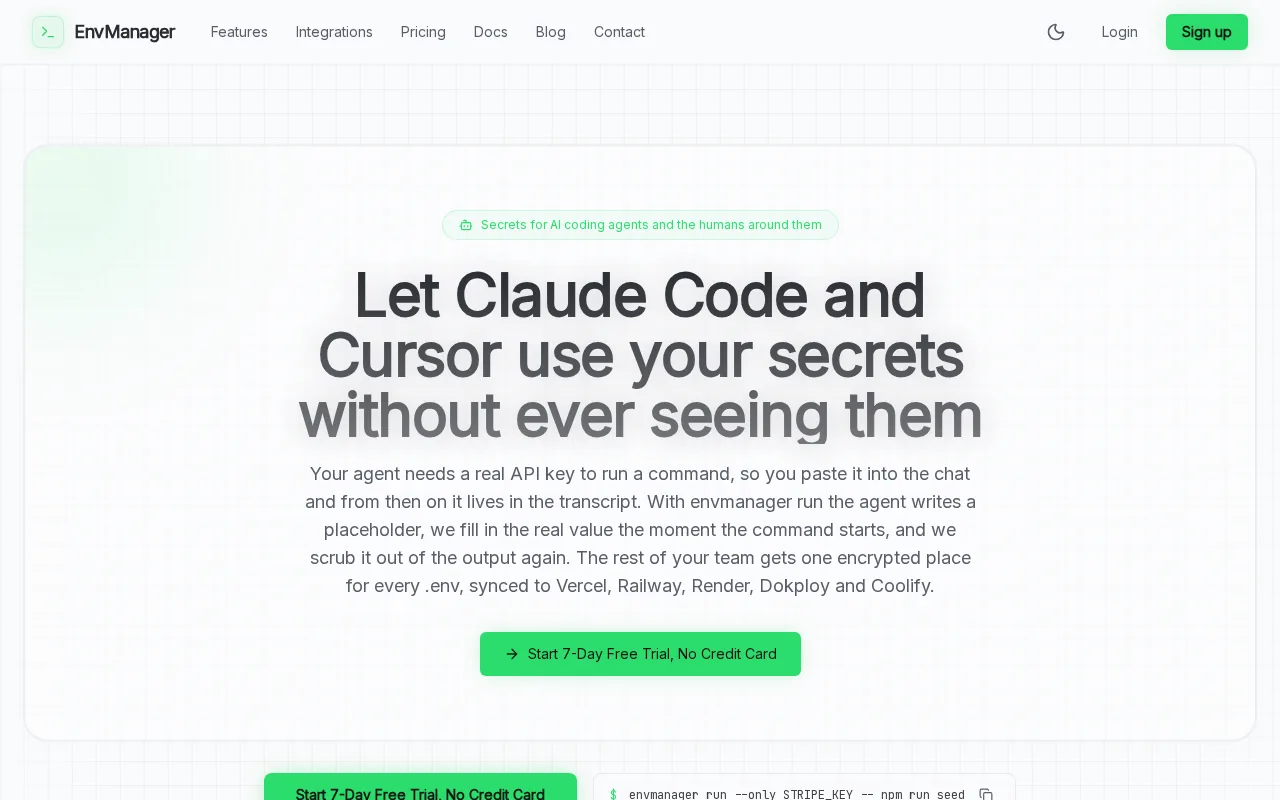
EnvManager is best for DevOps engineers, SaaS developers, and security teams that keep finding API keys in the wrong places. A scanner may catch an exposed token after it reaches a repository. EnvManager helps prevent that token from spreading in the first place.
We encrypt every value with AES-256 on import. Role-based access control, or RBAC, limits who can read or change each environment. An immutable audit trail records access and updates, so a security lead can review what changed without asking several engineers for screenshots.
The CI/CD workflow is simple. A build gets the values it needs at run time. Developers don't copy production credentials into local files or pipeline text. JIT access can also limit sensitive access to a short work window instead of leaving broad permissions in place.
That makes EnvManager a strong companion to API penetration testing tools. It doesn't replace an endpoint scanner or a manual proxy. It protects the credentials, test accounts, and environment values those tools rely on. Tokens should be scoped and kept out of source code. API authentication best practices
Best fit: Teams that need secure secret handling around API tests and deployments.
Watch before buying: You still need a separate tool to discover endpoints and test API behavior.
2. Escape: Automated API discovery and business-logic testing
Escape is an offensive security engineering platform for AppSec teams with large, changing attack surfaces. Its API testing focus goes beyond sending common payloads at known endpoints.

Escape is best for teams that need shadow API discovery and business-logic testing in the same workflow. It can find undocumented endpoints before testing starts. That matters when an API inventory depends only on old OpenAPI files or gateway records.
Its testing covers BOLA, IDOR, and authentication bypass cases. These flaws often need more than a single request. A tester must compare users, objects, permissions, and the order of actions. Escape supports multi-user testing and produces exploit evidence with multi-step reproduction sequences.
GraphQL teams get deeper coverage for issues such as introspection abuse, batch attacks, alias denial of service, and cyclic queries. Per-build CI/CD integration routes findings to the teams that own the affected assets. A public API, CLI, MCP server, and custom rule support give engineering teams ways to fit testing into existing workflows.
The platform also feeds findings back into regression testing. Once a flaw is found, later deployments can test whether the fix still holds. That closes a gap left by point-in-time penetration tests, where new code may ship before old findings are fixed.
Escape is a strong choice when proof of exploitability matters. The caveat is that advanced features may need specialist security knowledge, and some integrations remain under implementation.
Best fit: AppSec and offensive security teams that need continuous API coverage without adding more manual testers.
Decision rule: Pick Escape when shadow API discovery or business-logic depth is a hard requirement.
3. Burp Suite (by PortSwigger): Manual control for security researchers
Burp Suite is a manual API security testing toolkit for researchers who need full control over HTTP and HTTPS requests. It lets a tester capture traffic, change it, resend it, and inspect the response in detail.

Burp Suite is best when the key question is how an API behaves after a request changes. Its Repeater module supports careful request iteration. Intruder supports larger fuzzing tasks, such as testing alternate paths, parameters, or HTTP methods.
A tester can begin with an OpenAPI document, a browser session, or captured application traffic. When documentation is incomplete, browsing can reveal endpoints hidden behind front-end actions or JavaScript files.
The manual workflow is where Burp Suite earns its place. A researcher can change the Content-Type header, test different HTTP verbs, alter object IDs, or add undocumented parameters. That level of control helps with mass assignment checks and authorization tests that depend on the relationship between a caller and a resource.
The definition of an application programming interface is broad, but security testing gets specific fast. The tester needs to know which endpoint handles a resource, which method changes it, and which identity may use it. Burp Suite makes those request and response details visible.
The tradeoff is clear. Burp Suite rewards skilled testers and thoughtful test design. It won't replace a continuous discovery program for a large, fast-changing API estate. It also won't make a weak test plan strong by itself.
Best fit: Experienced security researchers who need request-level control.
Use it when: You need to validate a suspected authorization flaw or explore behavior that automated scans can't explain.
4. Postman: Flexible API validation for QA and security teams
Postman is a full-lifecycle API testing tool that QA and security teams can use before code reaches production. It fits teams that already maintain collections of requests and want to add security checks to that workflow.
Postman is best for validating auth flows, testing rate limits, and catching misconfigurations during development. It can check how an API responds to valid and invalid credentials. It can also test whether a service limits repeated requests as expected.
Pre-request scripts can capture JWTs and inject them into later requests. That helps a test collection follow a login flow instead of relying on a token pasted by hand. The result is easier to repeat when a token expires or a test account changes.
Postman works well for checks that belong close to functional QA. For example, a team can test an expired token, send a request with the wrong scope, then verify that the API rejects access to another user's object. The same collection can run again after a code change.
That flexibility has limits. Postman depends on the quality of the collection and scripts your team writes. It won't automatically discover every shadow endpoint or reason through a long business process. It is strongest when engineers know the expected API behavior and want repeatable validation.
Postman can support a focused, repeatable security workflow when its collections and scripts match the team's needs. Treat a free start as a test of workflow fit, not proof of full coverage.
Best fit: QA and security teams that want API security checks inside an existing request collection.
Good first test: Automate login, token capture, rate-limit checks, and one denied-access case.
5. ZeroThreat (by ZeroThreat.ai): Automated API testing at large scale
ZeroThreat is an automated penetration testing tool for APIs. It combines API discovery with AI-powered test cases and cloud-based scanning for teams that need a high volume of tests.
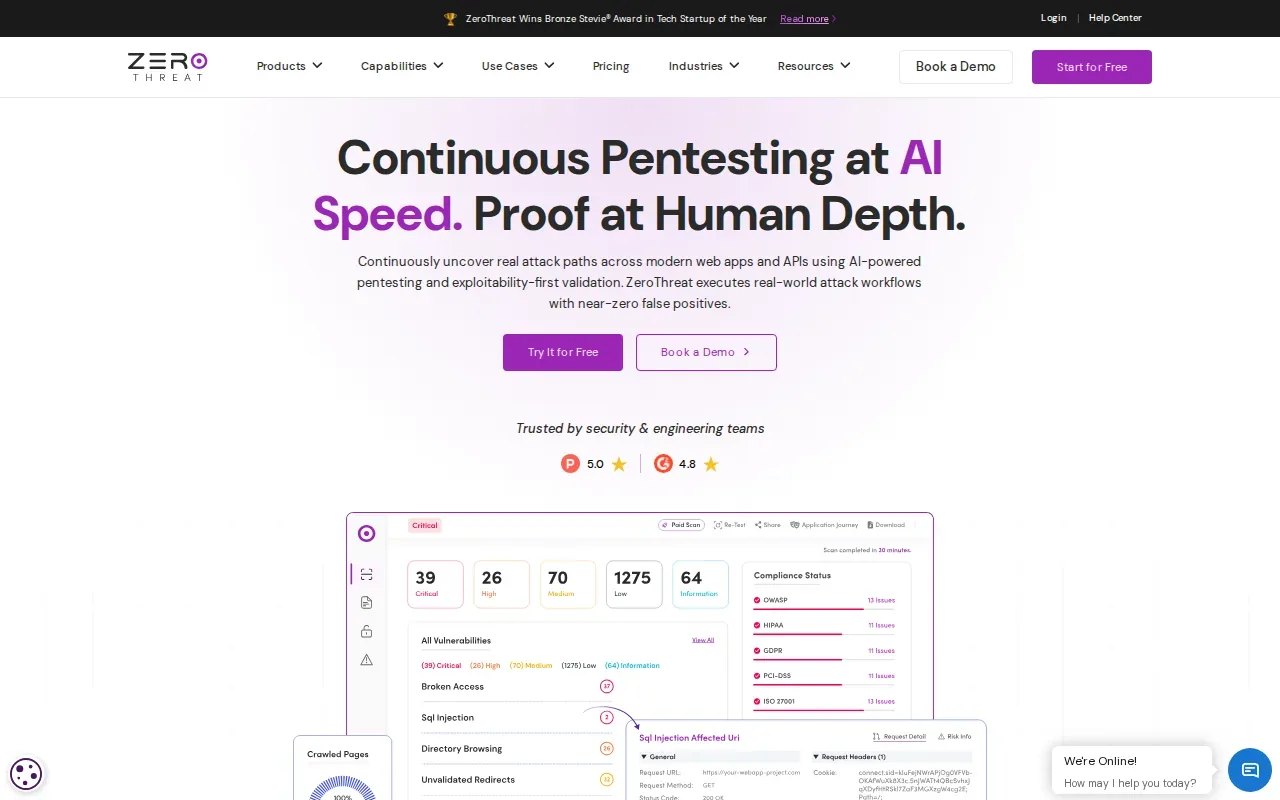
ZeroThreat is best for teams that want to map a broad API estate without building every test case by hand. Its discovery process maps endpoints. The platform then applies AI-driven test cases across the discovered surface.
That scale can help when endpoint lists change faster than a security team can update them. A new service may expose many routes, while an old inventory still shows only the routes that existed during the last release. Automated discovery gives the team a starting map for review.
ZeroThreat also supports continuous testing through cloud-native scanning. This is useful for distributed engineering groups that don't want to maintain a large scanner fleet. The listed free tier includes premium functionality, which makes it an outlier in a market where free access is uncommon.
Automation still needs review. A large test count tells you that the tool can exercise many paths, but it doesn't prove that every business rule is understood. Teams should inspect sample findings, confirm how authenticated tests work, and check whether the output gives engineers enough evidence to reproduce an issue.
Best fit: Organizations that need automated API discovery and high-volume testing.
Caveat: Pair broad automated coverage with manual review of sensitive workflows and access rules.
API penetration testing tools comparison: Match capabilities to your team
The best API penetration testing tools differ less by feature count than by the work your team must do each week. Start with the risk that keeps escaping your current process.
Automation and integration detail vary across the tools in this comparison. That gap can turn a promising demo into a long implementation project.
| Tool | Best fit | Main testing angle | Pipeline signal | Watch before buying |
|---|---|---|---|---|
| EnvManager | Teams securing API test secrets | Encrypted environment values and access control | Secret sync to CI/CD | Needs a separate endpoint testing tool |
| Escape | AppSec teams with changing attack surfaces | Shadow API discovery and business-logic flaws | Per-build testing, API, CLI, and custom rules | Advanced features may need specialist knowledge |
| Burp Suite | Experienced security researchers | Manual request analysis and fuzzing | Depends on your testing workflow | Requires skilled testers and a clear plan |
| Postman | QA and security teams | Auth flows, rate limits, and misconfiguration checks | Scripted request collections | Coverage depends on collection quality |
| ZeroThreat | Teams needing high-volume automation | Discovery and AI-powered test cases | Cloud-native continuous testing | Review evidence and authenticated coverage |
Use EnvManager when the weak point is credential handling. Choose Burp Suite for hands-on investigation. Choose Postman when QA already owns repeatable request collections. Escape fits teams that need business-logic depth, while ZeroThreat fits teams that need broad automated discovery.
Before a wider rollout, test one production-like API in a safe environment. Give the tool a real auth flow, one role boundary, and one sensitive object. Then check whether the finding reaches the right owner and whether the team can reproduce it.
For a wider view of secret handling, endpoint testing, and pipeline fit, compare the API security testing tools and their workflow signals before you commit.
FAQ: API penetration testing tools
What are API penetration testing tools?
API penetration testing tools help teams find weaknesses in API endpoints, authentication, authorization, input handling, and business rules. Some tools scan automatically, while others give a tester direct control over requests. The best choice depends on whether you need discovery, repeatable checks, manual investigation, or secure handling of test secrets.
Which API penetration testing tool is best for business logic flaws?
Escape is the strongest fit in this shortlist for business-logic flaws because it supports tests for BOLA, IDOR, and authentication bypass. It also supports multi-user testing and exploit evidence. Burp Suite can investigate the same class of issue manually, but it depends more heavily on the tester's skill and test design.
Can Postman be used for API security testing?
Yes, Postman can support API security testing through scripted request collections. Teams can validate auth flows, test rate limits, and check misconfigurations before release. Pre-request scripts can capture JWTs and pass them into later requests. Postman works best when the team already knows the expected API behavior.
Are API penetration testing tools free?
Some API penetration testing tools have free tiers, but free access is uncommon across the market. ZeroThreat lists a free tier with premium functionality. Cost is only one part of the decision. Confirm scan limits, authentication support, report detail, and CI/CD access before treating a free tier as a long-term plan.
Does EnvManager replace an API penetration testing scanner?
No, EnvManager doesn't replace an API penetration testing scanner. It protects the API keys, tokens, and environment values that scanners and test suites need. Teams can use RBAC to control access, then sync approved secrets to local environments or CI/CD jobs. Pair it with an endpoint testing tool for full coverage.
What should I test first with an API security tool?
Start with authentication, object-level authorization, and one sensitive workflow. Use a real test account with limited permissions. Then try an expired token, a different user's object ID, and an invalid request method. This small test shows whether the tool can handle your auth flow and produce evidence your engineers can act on.
Conclusion
For most teams, the right stack pairs one testing tool with disciplined secret management. Use Escape for continuous business-logic coverage, Burp Suite for manual research, Postman for scripted QA checks, or ZeroThreat for broad automation. Add EnvManager when API credentials and .env files are part of the risk. Start with one production-like API and run a controlled test this week.