
API Authentication Best Practices: A Practical Guide
Learn API authentication best practices for OAuth 2.0, API keys, token security, access control, rotation, monitoring, and secret storage.
Many API breaches start with valid credentials, not missing login checks. A common trap is using JWTs for browser sessions, which can expose apps to replay attacks when tokens are stored poorly. These API authentication best practices show where OAuth 2.0, API keys, secret management, and request checks fit.
1. EnvManager
EnvManager is a self-serve secret manager for teams that need API credentials outside their codebase. We encrypt environment values with AES-256, keep versions, and control access with role-based access control, or RBAC.
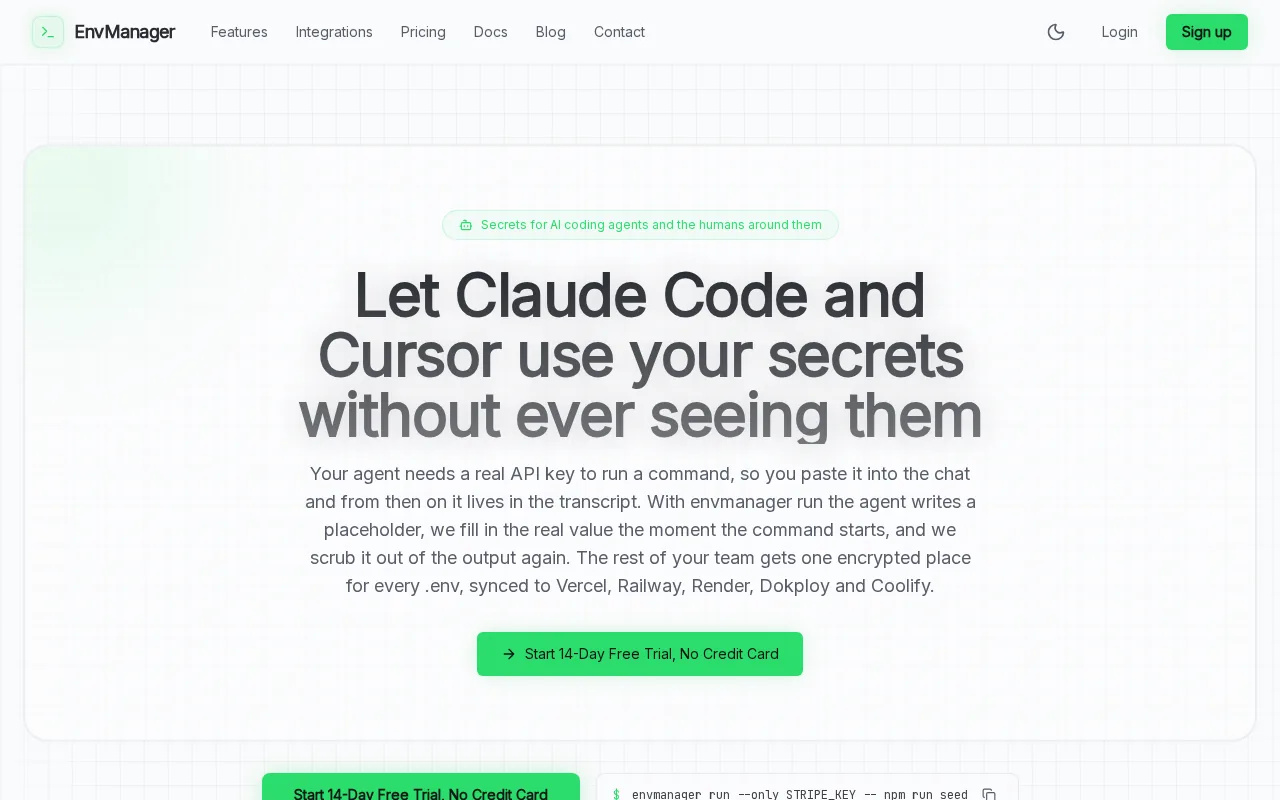
That workflow solves a common failure point. A developer adds an API key to a local .env file, copies it into a CI/CD setting, then pastes it into a ticket during a failed deploy. Each copy becomes another place where the key can leak.
EnvManager keeps one controlled source for those values. Teams can sync secrets to local machines and pipelines without putting credentials in source files. Version history also gives you a clear record when a value changed or when a bad change needs to be rolled back.
Access control matters just as much as encryption. A developer may need a development key, while a release job needs production access. RBAC lets you separate those paths. An immutable audit trail can then show who accessed a secret and when.
We recommend treating secret storage as part of API authentication, not as a separate task. Your API may reject bad tokens, but that control fails if the token sits in a public repository or appears in a build log. Our API key security rules cover the storage and rotation work around that risk.
EnvManager also fits teams that need a simple handoff. A new engineer can receive the right environment through an assigned role instead of asking for a key in chat. A CI job can pull the value at run time, then keep it out of the repository.
The caveat is scope. Secret management doesn't decide whether an API request has the right business permission. You still need token validation, narrow scopes, TLS, and checks on the requested resource. EnvManager protects the credentials that make those controls possible.
Choose the Right Authentication Method for Each API
The right method depends on who calls the API, how sensitive the data is, and how quickly access must end. API authentication best practices favor short-lived, scoped tokens for user-facing and high-risk systems, while API keys can work for simpler integrations.
| Method | Good fit | Main control | Watch out for |
|---|---|---|---|
| OAuth 2.0 | User access and third-party apps | Scopes plus token expiry | Complex setup and weak validation |
| API key | Controlled service access or public developer APIs | Key restriction and rotation | Long-lived keys copied into code |
| Signed access token | Distributed services that need local validation | Signature and claim checks | Replay risk and poor storage |
| Basic authentication | Limited legacy use over HTTPS | TLS and credential protection | Credentials travel with each request |
| mTLS | High-trust service-to-service calls | Two-way certificate checks | Certificate issue and renewal work |
OAuth 2.0 is the usual choice when a user grants an app limited access. Scopes can separate read access from write access. OpenID Connect adds identity details when the API needs to know which user signed in.
For machine-to-machine access, the client credentials flow keeps the steps clear. The client authenticates with an authorization server. The server returns a temporary access token. The client sends that token to the API, which checks its issuer, audience, signature, scope, and expiry.
This pattern is shown in AWS's machine-to-machine authentication flow. The client secret goes to the authorization server, not to every protected API request. That limits where the long-lived credential must be trusted.
API keys have a narrower role. They can suit a low-risk internal tool or a public API where a developer needs a quick identifier. Restrict each key by environment and permission. Store it outside the repository. Give it an owner and a clear expiry plan.
Basic authentication should be a fallback, not a default. It sends the same username and password with each request, so HTTPS is mandatory. Even then, a stolen credential may remain useful until someone changes it.
Signed access tokens can work well between distributed services because the API can validate claims without a session lookup. But don't treat a signed access token as a magic security layer. The server must reject the wrong algorithm, issuer, audience, signature, or expiry. For browser sessions, keep access tokens in memory when the design permits it. Avoid placing sensitive tokens in locations that JavaScript or injected code can read easily.
Protect Tokens, Credentials, and Secrets Throughout Their Lifecycle
Token security starts before the first request. It covers creation, storage, use, renewal, revocation, and deletion. A token that expires on paper but remains in logs is still a live incident risk.
Keep access tokens short-lived. The exact lifetime should match the data and action involved. A token that can read public catalog data has a different risk than one that can change billing records.
Refresh tokens need tighter controls because they last longer. Store them in a protected location. Rotate them after use, and reject an old refresh token if someone tries to reuse it. Rate-limit refresh attempts by identity or client. A burst of refresh failures can signal guessing or theft.
Revocation fills the gap between discovery and expiry. You may revoke a token when a user signs out, an employee changes roles, or a service shows unusual behavior. Opaque tokens make central revocation simple. JWTs need a plan for deny lists, short lifetimes, or a validation check that can stop them sooner.
Secrets also need a home during development and delivery. Don't place them in source code, Docker images, pull requests, tickets, or CI configuration files. Inject values at run time, then mask them in build output.
EnvManager supports this pattern by keeping .env values encrypted and versioned. We let teams sync the right values to local workstations and CI/CD pipelines. For teams comparing secret storage approaches, our API key manager guide focuses on encryption, RBAC, rotation, audit logs, and pipeline support.
Scan for exposed credentials before they reach production. Search commits, pull requests, container layers, and build logs. If a key appears, assume it may have been copied. Revoke it first, then remove the exposed value and investigate where it traveled.
Set a rotation owner for every credential. A schedule without an owner becomes a reminder that nobody acts on. Automated rotation helps, but it still needs a test path. Rotate a non-production key and confirm each dependent service recovers before applying the same change in production.
Enforce Secure Transport, Scopes, and Request Protections
Secure API authentication best practices require more than a valid token. The request must travel through an encrypted channel, ask for an allowed action, and target a resource the caller may use.
Use TLS for every API connection. Do not send credentials over plain HTTP, even on an internal network. For service-to-service traffic with a higher trust requirement, mutual TLS lets both sides present certificates. That blocks a client that has no trusted machine identity.
Scopes should describe the smallest useful permission. A read token should not gain write access because the same service happens to support both. Split sensitive actions into separate scopes, then check the scope at the endpoint that performs the action.
Authorization must also check the object being requested. A token may be valid while the requested account, order, or file belongs to someone else. Validate the relationship between the caller and the resource on the server.
Replay protection matters when an attacker captures a valid request. Add short token lifetimes where possible. For signed requests, bind the message to a timestamp, nonce, or request ID. Reject reused nonces and stale timestamps.
These controls also apply to automated agents. Guidance on securing model and agent interactions recommends scoped temporary credentials, strict request schemas, TLS with mutual checks, and replay defenses. The same logic fits ordinary internal APIs.
Static front ends need extra care. Never place a private API key in browser JavaScript. Route the request through a server-side proxy when the upstream service requires a secret. EnvManager's proxy functions for server-side API calls are designed for this pattern, so the browser receives the result without receiving the key.

One useful test is to change one claim at a time. Alter the issuer. Change the audience. Remove the scope. Reuse a nonce. Each case should fail with a safe response and leave no secret in the log.
Monitor Authentication Events and Test for Failure Conditions
Monitoring turns authentication from a code feature into an operating control. You need to know when tokens are issued, rejected, refreshed, revoked, and used in odd ways.
Record useful event data without recording secrets. Include the client or service identity, endpoint, result, time, request ID, and source context. Never log access tokens, client secrets, passwords, or full authorization headers.
Watch for patterns that deserve review:
- Repeated failures from one client or identity.
- A sudden increase in refresh attempts.
- One token used across distant locations or services.
- Access to an endpoint outside the caller's normal scope.
- Requests that continue after a credential should be revoked.
Use separate alerts for availability and abuse. A broad outage may produce many failed logins, while a single successful request with an unusual scope may deserve a faster security response. The signal depends on context.
Authorization failures are a major concern for APIs. The related API security guidance is a useful reminder: a passing authentication check does not prove that the request is safe.
Test failure paths in every release. Send an expired token. Use a token from the wrong issuer. Remove the signature. Change the subject. Try a valid token against another user's object. Check that the API denies each request and returns only the detail a client needs.
Test the recovery path too. Revoke a credential in a staging environment. Confirm that the service stops using it. Then rotate the secret through the same process your production pipeline uses. A recovery plan that exists only in a document won't help during an incident.
Keep a small audit review for high-risk identities. A manager or security lead should be able to see which service can write data, where its secret lives, and who can change it. EnvManager's version history and access controls can support that review, but your API still needs its own request logs.
FAQ
What is the safest API authentication method?
OAuth 2.0 with short-lived access tokens is a strong default for user and delegated access. It separates client credentials from API calls and supports narrow scopes. For service-to-service traffic, add mutual TLS when both sides need verified machine identities. The safest choice still depends on correct server-side validation and secret handling.
Are API keys safe to use?
API keys can be safe for controlled, lower-risk integrations when you restrict them and rotate them. Keep each key outside source code and logs. Give it only the access it needs. For user access or sensitive actions, short-lived OAuth tokens usually provide better control than a static key.
Should JWTs be used for browser sessions?
JWTs aren't automatically safe for browser sessions, especially when stored where injected script can read them. Use short-lived tokens and keep them in memory when that fits your design. Validate the signature, issuer, audience, and expiry on every request. A JWT format does not replace sound session design.
How often should API tokens be rotated?
Rotate tokens based on their risk, use, and exposure. High-risk credentials need shorter lifetimes and faster replacement. Refresh tokens should rotate after use, with reuse detection. Static service keys need an assigned owner and a tested rotation path. Don't wait for a breach before learning whether rotation works.
How do you keep API credentials out of code?
Keep credentials in a managed secret store and inject them at run time. Block secrets in commits with scanning and review checks. Mask values in CI logs. Limit access by environment and role. A tool such as EnvManager can centralize encrypted .env values while your application handles token validation.
Conclusion
Use short-lived, scoped tokens for sensitive access, enforce TLS, and validate every claim and resource on the server. Then move your keys and tokens into controlled secret storage. Start by listing one production API's credentials, owners, scopes, and expiry dates. Runenvmanager pullonly after you have defined who should receive each value.