
Best API Governance Tools for 2026
Compare API governance tools for API design, policy checks, security, and lifecycle control. Find the right fit for your team and delivery workflow.
API governance can get messy fast: teams ship different standards, API specs drift, and security checks happen too late. API governance tools help set rules across an API’s lifecycle, but core controls such as audit logs and role-based access aren’t universal. Here are five options, each suited to a different part of the work.
We analyzed 34 comments and questions from Reddit, Quora and YouTube about API governance tools and found that 24% mentioned the unified governance of APIs, events, and AI agents.
1. Treblle: Runtime intelligence for API discovery and governance
Treblle is an enterprise runtime intelligence platform for discovering and governing APIs and agents across cloud environments. It checks OpenAPI specs and live request and response traffic, so teams can compare the contract with what an API does in production.
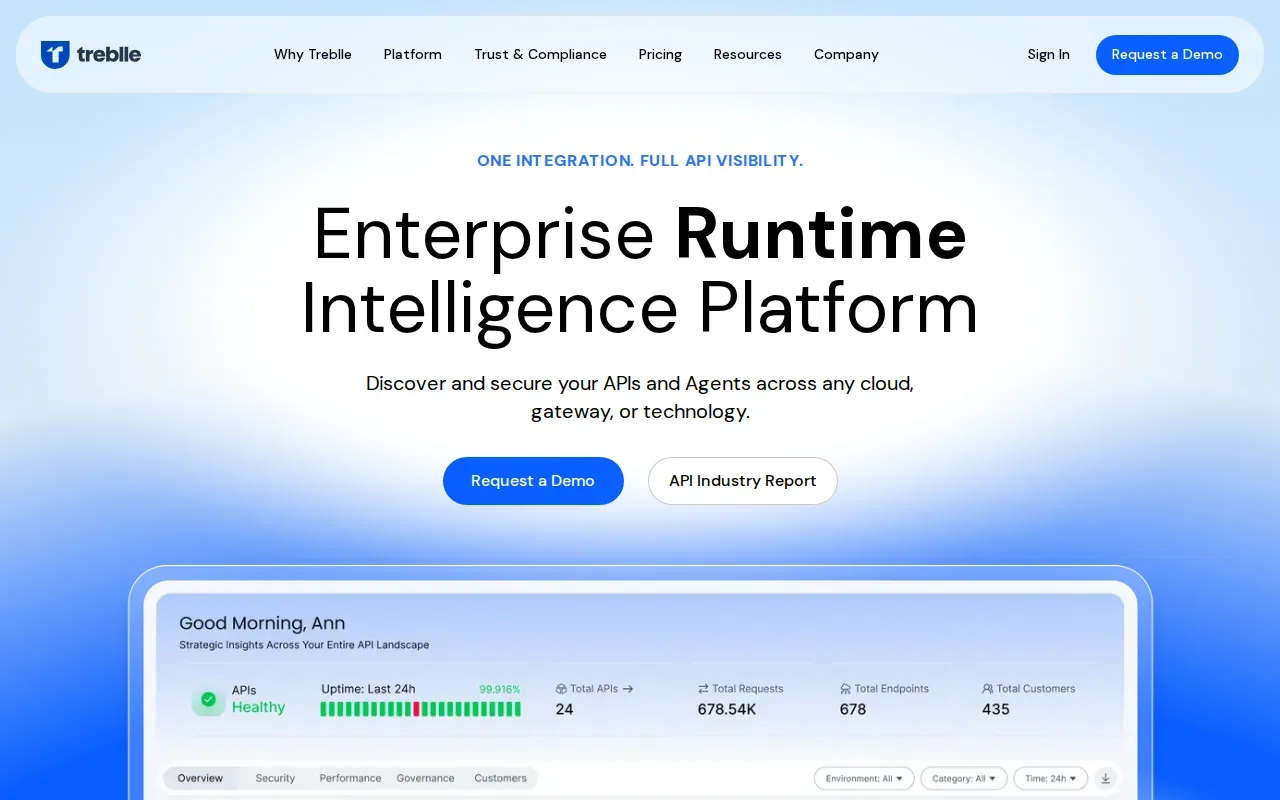
Its governance checks cover design quality, security, performance, and AI readiness. Each API gets a score from 0 to 100, with a letter grade. Teams can track scores by API version and review leadership reports without manually gathering results.
For example, a clean spec can still hide production behavior that breaks a team’s standards. Treblle’s design-to-production view helps identify where those scores diverge. Teams can also add their own rules in Spectral format, alongside the built-in checks.
Checks can run during design, in CI/CD, and against live traffic. The CLI can block a pull request or deployment when an API fails the chosen governance rules. If shadow APIs are part of your concern, compare this work with the separate problem of API discovery across an organization.
Treblle fits teams that want a shared quality view across API design and runtime behavior. Its scores and reports can help leaders spot changes over time, while developers can see which checks failed. A useful fit when governance needs to cover more than the document alone.
2. Spectral by Stoplight: Policy-as-code linting for API descriptions
Spectral by Stoplight is an open-source linter for API descriptions. It lets teams turn style rules into checks, then run those checks during API design or in CI workflows.
Spectral works with JSON and YAML. Its rulesets are built with OpenAPI, AsyncAPI, and JSON Schema in mind. Teams can start with default rules or write their own, such as rules for naming or URL patterns.
That makes it useful when several teams write API contracts and need the same baseline. Put the ruleset under version control, run it on a pull request, and block a merge if the spec breaks a required rule. The OpenAPI Specification gives teams a shared format for describing APIs; Spectral can check those descriptions against their own standards.
Spectral can run as a command-line tool or as an NPM or Yarn package. It can also fit into editors and continuous integration. That keeps the feedback close to the spec, instead of relying only on a review after implementation.
One important distinction: a linter checks API descriptions. It isn’t the same as a runtime gateway or a full API inventory. Teams that need those controls should map them to other parts of their governance setup. For API rules that cross services and delivery systems, our policy-as-code tool overview gives useful adjacent context.
Pick Spectral when portable, customizable spec rules are the main need. It gives developers a direct way to catch style violations before they become repeated review comments.
3. 42Crunch: OpenAPI contract analysis with CI/CD prevention
42Crunch applies a security-focused lens to OpenAPI contract analysis. It audits API descriptions and can use CI/CD plugins to check changes as developers commit them.
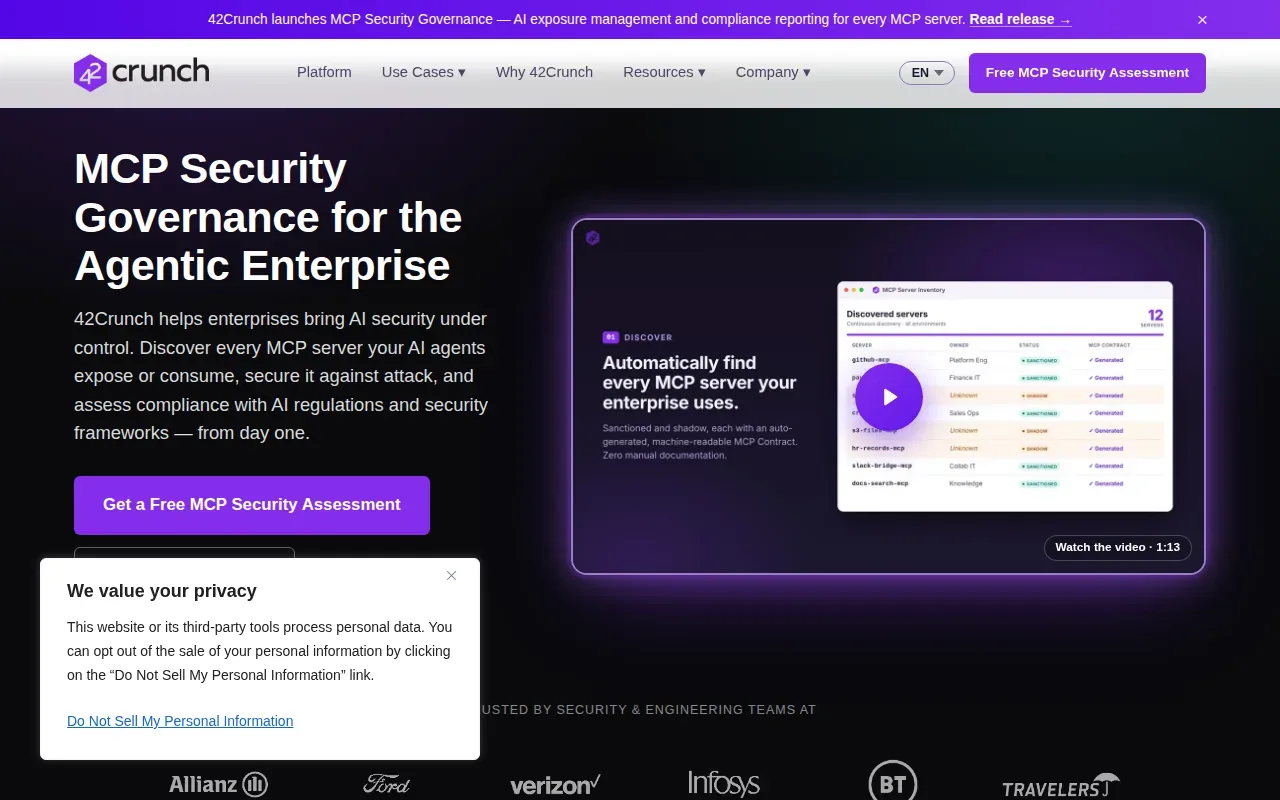
That contract-first approach gives teams a machine-readable definition to review and test. An OpenAPI contract can describe endpoints, authentication schemes, response shapes, and error codes. A clear contract also helps API producers and consumers work from the same stated behavior.
In a pipeline, 42Crunch can audit API definitions after a Git push. Teams can set quality criteria, and a failing check can stop the build so the change doesn’t move forward. This turns a security rule into a delivery gate rather than a reminder in a document.
Its CI/CD integration also supports GraphQL files. GraphQL federation isn’t supported in that integration. Teams should follow product safety guidance and keep invasive scans away from production systems and data.
42Crunch is a strong match for organizations standardizing on OpenAPI-first development, especially when security checks belong in CI/CD. Use it when you want a contract reviewed before release, then decide separately how to govern ownership, API catalogs, and runtime policies.
4. Apigee by Google Cloud: API management with advanced automation
Apigee by Google Cloud is an API management platform that uses proxies to control how clients reach backend services. The proxy layer lets teams apply policies without changing the backend itself.
Apigee supports REST, gRPC, SOAP, and GraphQL. Its policies can manage security, rate limits, quotas, and data changes in requests or responses. That broad protocol support can help teams that need one management layer across different API styles.
For governance, API products can be published through developer portals, where consumers find documentation and sign up to use APIs. That helps make APIs easier to discover and gives producers a place to share updates. Built-in dashboards can show traffic patterns and help teams investigate performance changes.
Apigee also supports advanced automation workflows. The platform’s API hub can bring specifications into a central catalog, while its proxy model gives teams a place to apply common controls.
Apigee fits organizations that need API management across varied use cases and environments. During evaluation, decide which controls belong in the proxy and which standards should stay in API design or CI/CD. Those layers solve related, but different, problems.
5. Azure API Management by Microsoft: API lifecycle management in Azure
Azure API Management by Microsoft supports publishing, securing, transforming, monitoring, and managing APIs. It’s built around the Microsoft Azure ecosystem and supports APIs across the lifecycle.
Its central catalog supports API discovery and governance. Teams can apply authentication, authorization, rate limits, and transformations across APIs. The platform also supports a federated model, so separate teams can manage their APIs while a central group keeps oversight.
That balance matters in a large organization. A platform group can set shared rules, while domain teams make routine API decisions within those guardrails. Azure API Management also has role-based access control and audit logs, which give administrators access controls and a record of activity.
Azure’s gateway supports REST, GraphQL, WebSocket, and OData. Self-hosted gateways can run in Azure, on-premises, or across other clouds, with management centralized through Azure. For teams that need to protect gateway traffic, these API gateway security practices cover related operational concerns.
Choose Azure API Management when Azure is already a key part of your operations and you need lifecycle controls plus federated team management. Check which tier and gateway setup fit your workloads, since the product has tier-based pricing and feature sets.
Compare the Five API Governance Tools
These products work at different points in the API lifecycle. A linter can enforce spec rules, while a management platform can apply runtime controls. Compare each tool against the governance gap you need to close first.
| Tool | Main governance layer | Good fit when | Evaluation question |
|---|---|---|---|
| Treblle | Design checks and live traffic | You want to compare spec quality with production behavior. | Which built-in or custom checks should affect the score? |
| Spectral by Stoplight | API description linting | You need portable style rules in design and CI workflows. | Which rules should block a merge? |
| 42Crunch | Contract security checks in CI/CD | You’re standardizing on OpenAPI-first development. | What criteria should fail the build? |
| Apigee by Google Cloud | Proxy-based API management | You need a policy layer across API types and environments. | Which controls belong in the proxy layer? |
| Azure API Management by Microsoft | Lifecycle governance and federated management | Your teams need shared Azure controls with local API ownership. | How will central and domain teams split responsibility? |
Before a proof of concept, write down the controls you need at design time, in CI/CD, and at runtime. Then test a real API change against them. That will show whether a tool fits your workflow better than a feature checklist can.
FAQ
What are API governance tools?
API governance tools help teams set and enforce standards across an API’s lifecycle. Depending on the product, they may check API descriptions, block policy violations in CI/CD, manage gateway rules, or track APIs in a catalog. Governance also needs clear ownership and rules for version changes, exceptions, and retirement.
What’s the difference between API governance and API management?
API governance sets the standards and decision rules for how APIs should be built and run. API management handles operational work such as routing, access policies, and traffic controls. The two overlap, but a gateway alone won’t define API ownership or decide how teams handle breaking changes.
Which tool is best for API design rules?
Spectral by Stoplight is a direct fit when your main goal is to lint API descriptions against shared rules. Teams can use or extend rulesets, then run checks in design workflows or CI. If you also need runtime monitoring or gateway policies, plan for those controls separately.
How do I add governance checks to CI/CD?
Put machine-checkable rules in the delivery pipeline and decide which failures should stop a merge or build. Spectral can lint API descriptions, while 42Crunch can audit contracts and fail a build against set criteria. Start with a small set of required rules, then add checks as teams agree on the baseline.
Can API governance work across independent teams?
Yes. A federated model lets domain teams manage their own APIs inside shared organization-wide rules. A central platform group can maintain the baseline and monitor compliance, while teams keep control of routine design choices. Azure API Management documents this model through workspaces and centralized oversight.
Conclusion
Choose the tool that covers your biggest gap first: contract rules, security checks, runtime behavior, or federated management. If API keys and environment values also move through your delivery workflow, EnvManager can manage those secrets separately from API governance. Start by testing one API change against your required checks.