Best SOC 2 Compliance Software in 2026
Compare the best SOC 2 compliance software for evidence collection, monitoring, policy management, audits, and secure developer workflows in 2026.
SOC 2 work can block an enterprise deal when your team can't prove how it protects customer data. The right software cuts the spreadsheet work, but automation alone isn't enough. Here are seven named options, with the best fit, tradeoffs, and controls to check before you buy.
We pulled the current G2 review pages for Vanta, Drata, Secureframe, and Scrut Automation, four SOC 2 compliance platforms. Vanta shows 2,665 reviews at 4.6 stars, Drata 1,337 at 4.7, Secureframe 804 at 4.7, and Scrut 1,312 at 4.9, a combined 6,118 reviews. G2 groups all four under its security compliance and cloud compliance categories, not under a secrets management category. That split shows compliance automation platforms track policies and evidence, while secret handling for environment variables sits in a separate product category entirely.
1. EnvManager, secure secrets management for SOC 2 readiness
EnvManager is a self-serve SaaS platform for encrypted, version-controlled environment files. It fits DevOps teams that need tighter control over secrets in local development and CI/CD.
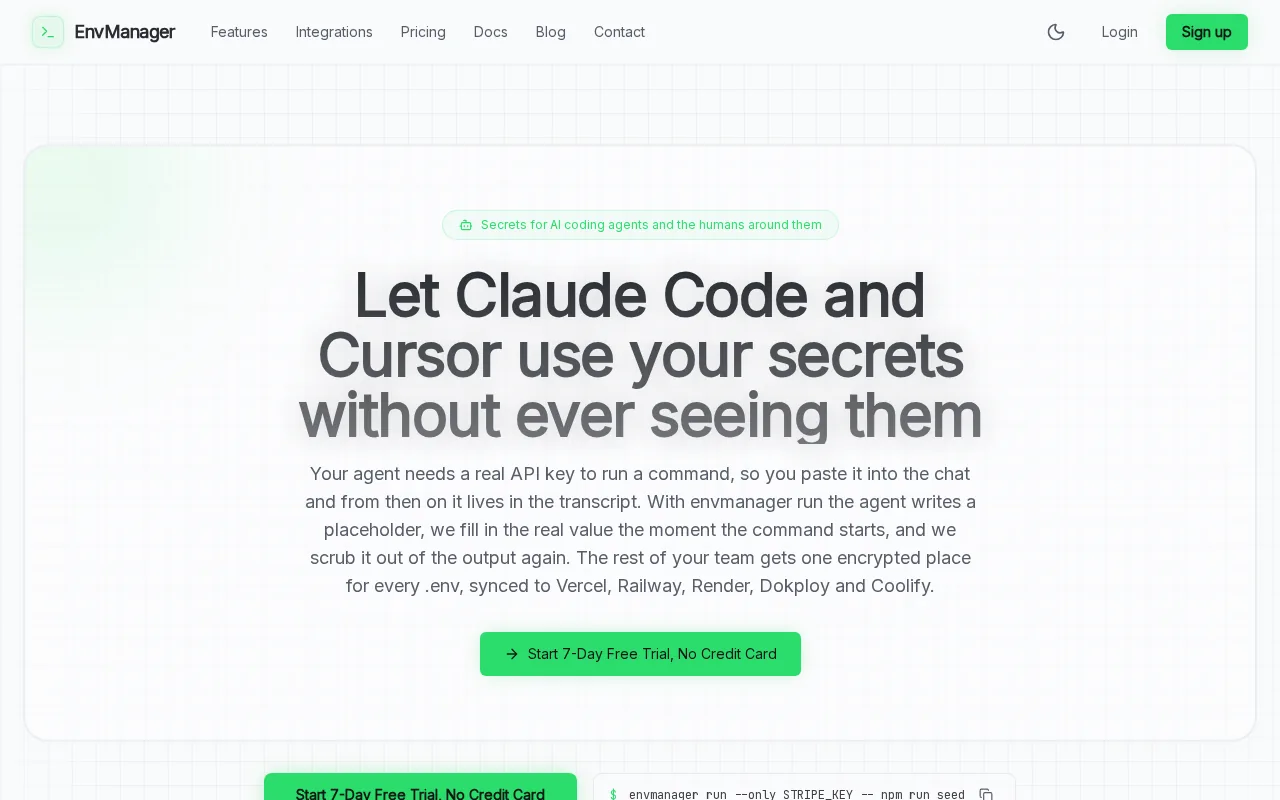
We encrypt every value with AES-256 on import. Teams can apply role-based access control, keep an audit trail, and sync approved secrets to local machines or deployment pipelines. That gives security owners a clear answer when an auditor asks who accessed a secret, what changed, and where the value was pushed.
The developer workflow matters here. A secret copied into Slack or pasted into a shared file can spread far beyond its intended scope. EnvManager keeps the source of truth in one place, then lets developers pull approved values into the workflow they already use.
Readiness software can track policies, but it can't fix weak secret handling by itself. EnvManager also isn't a replacement for a SOC 2 audit platform, CPA firm, or full risk program. Use it as the developer-side control layer.
For a closer look at secret controls, see EnvManager security features for encrypted secrets and audit logs. Runenvmanager pullafter access is approved.
2. A-SCEND, automated evidence collection for audit preparation
A-SCEND is aimed at teams that want automated evidence collection during SOC 2 audit preparation. It suits companies working with an audit partner that already uses the same workflow.

Evidence collection is one of the slowest parts of readiness work. A-SCEND is cited for pulling evidence into the audit process, which can reduce manual requests and repeated screenshots. The broader process still needs scope decisions, control owners, and a review of gaps.
A SOC 2 report examines controls across Security, Availability, Processing Integrity, Confidentiality, and Privacy. Security is required, while the other criteria depend on the service and customer needs. A-LIGN's SOC 2 overview also notes that a licensed CPA firm must conduct the examination.
Type I checks control design at one point in time. Type II checks whether controls work over a period, often three to twelve months. That distinction changes the evidence you need and the time your team must stay consistent.
The caveat is simple: automated collection doesn't mean automatic compliance. Your team still has to fix access gaps, write workable policies, and keep controls running during the observation period.
3. Vanta, continuous monitoring for ongoing compliance
Vanta is built for teams that want continuous compliance monitoring after the first audit. It fits SaaS companies with many cloud, identity, code, and device systems to check.
Vanta describes automated tests that monitor controls hourly. It can connect to tools such as AWS, Azure, Okta, GitHub, and Wiz, then map collected evidence to controls. That model helps a team spot drift before an auditor or customer finds it.
The product also supports policy work, access reviews, risk reviews, employee acceptance, and auditor collaboration. Its Trust Center can help sales teams answer security questions without sending the same files to every prospect.
That breadth is useful when compliance has moved beyond one audit. A team may start with SOC 2, then reuse evidence for another framework. Choose Vanta when ongoing monitoring matters more than a narrow, one-time readiness project.
4. Drata, automated evidence collection and policy workflows
Drata focuses on automated evidence collection and compliance workflows. It fits teams that want one workspace for policies, controls, owners, and audit requests.

The main appeal is a shared operating view. Instead of asking an engineer for the same proof twice, an owner can connect evidence to the control it supports. That makes it easier to see what is complete, what is stale, and who owns the next task.
Policy work needs care. A template that says employees review access every year is only useful if someone does the review and stores the result. Auditors compare written promises with proof that the work happened. Software can assign the task, but a person still needs to approve the policy and act on exceptions.
Drata lists pricing as contact sales. That makes budget planning harder for small teams, especially when audit fees, penetration testing, staff time, and remediation sit outside the subscription. Ask for a written breakdown before you commit.
Drata is a reasonable fit when policy ownership and evidence collection must live together. It may feel heavier than needed for a small team with one product and a narrow scope.
5. Scrut, tamper-evident audit trails and broad integrations
Scrut combines compliance automation with risk and audit tracking. It suits teams that care about audit history, broad integrations, and a record of who changed what.
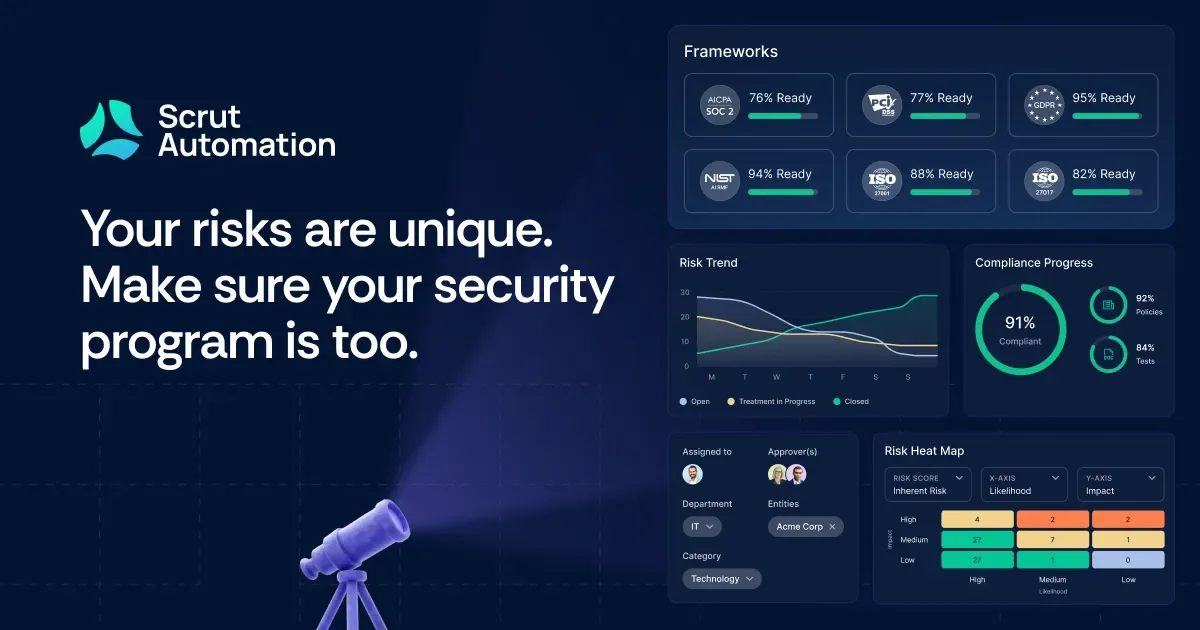
Scrut is the clearest option in this shortlist for a tamper-evident, timestamped audit log. The record cannot be edited after the fact, which matters when reviewers need confidence that evidence history has not been rewritten.
Its stated integrations include AWS, GCP, GitHub, Okta, Google Workspace, and Jira. That mix covers cloud, code, identity, collaboration, and task tracking. Scrut also describes automated evidence collection and control monitoring.
It is worth checking how each integration behaves before signing. A read-only connection may collect configuration data, while another connector may need event history or ticket status. Ask which tests run automatically and which still need human evidence.
| Decision point | Scrut fit | Question to ask |
|---|---|---|
| Audit history | Tamper-evident, timestamped log | How long is history retained? |
| Evidence work | Automated collection is highlighted | Which controls need manual proof? |
| Tool coverage | Cloud, code, identity, and work tools | Are our exact accounts supported? |
| Governance | Role-based access is described | Can permissions match audit roles? |
One warning applies to every compliance platform: a large integration count does not prove useful coverage. Test the controls that matter to your report scope, not the size of a vendor's catalog.
6. Secureframe, automated reminders for audit readiness
Secureframe is a fit for teams that need reminders to keep readiness tasks moving. It is especially useful when control owners sit across engineering, HR, operations, and leadership.
Automated reminders can prevent small tasks from becoming audit blockers. An owner may need to review access, accept a policy, complete training, or upload evidence. A scheduled prompt gives that task a clear place in the workday.
Secureframe should not be judged only by its reminder system. Check evidence mapping, policy version history, integrations, auditor workflow, and access controls. A reminder can tell someone to review a secret store, but it can't show whether the store itself limits access.
Pick this option when follow-through is your biggest readiness gap. If your team already closes tasks reliably, another platform's audit depth may matter more.
7. Easy Audit, simplified evidence collection for smaller teams
Easy Audit is positioned around automated evidence collection. It fits smaller teams that want less manual gathering during audit prep.
A smaller company often has one person wearing the security, operations, and compliance hats. A focused evidence workflow can reduce the time spent hunting through cloud consoles, ticket systems, and shared folders.
That simplicity can be a strength, but it can also hide gaps. Confirm whether the tool supports your chosen Trust Services Criteria, policy approvals, access reviews, change management, and Type II observation work. Ask what happens when evidence is missing or stale.
Request the subscription terms and ask whether auditor support costs extra. Then add the likely internal work, such as fixing branch protection, reviewing user access, or replacing shared secrets.
Easy Audit makes the most sense when your scope is narrow and your team wants a short path to evidence collection. Larger programs may need deeper risk, policy, and audit-log controls.
How to choose among these platforms
Start with scope, not a feature count. Decide which Trust Services Criteria apply, whether buyers need Type I or Type II, and which systems hold customer data.
- Evidence: Can the tool collect proof from your cloud, code, identity, and ticket systems?
- Security: Does it show RBAC, least privilege, MFA evidence, and a strong audit trail?
- Developer fit: Can engineers resolve failures inside their normal CI/CD workflow?
- Audit fit: Can your CPA auditor review evidence without endless email threads?
- Cost: What is included in the subscription, and what remains an internal or audit expense?
Get a quote that separates software, implementation, auditor fees, and add-ons.
Secrets deserve their own control plan. Our audit and compliance workflow for EnvManager helps teams review secret activity and deployment history alongside their wider program.
FAQ: SOC 2 Compliance Software
What does SOC 2 compliance software do?
SOC 2 compliance software helps teams map controls, collect evidence, manage policies, and track readiness. Some tools also monitor connected systems for changes. It does not issue the SOC 2 report. A licensed CPA firm still performs the independent examination and decides whether the controls meet the report requirements.
Is SOC 2 Type I or Type II better?
Type II usually gives customers stronger assurance because it tests whether controls work over time. Type I checks the design and presence of controls at one point. Choose Type I when you need an early report and buyers accept it. Choose Type II when enterprise customers want evidence of ongoing operation.
How long does SOC 2 preparation take?
SOC 2 preparation can take weeks to months, depending on scope, control gaps, and the report type. Type II adds an observation period that may last three to twelve months. Software can reduce evidence work, but it cannot remove the time needed to fix systems, train staff, and prove that controls keep working.
Does SOC 2 software replace an auditor?
SOC 2 software does not replace an auditor. It organizes evidence and helps your team stay ready, while an independent CPA firm performs the examination and issues the report. Treat a platform as an operating aid, not as proof that your program will pass.
What security features should SOC 2 software have?
Look for role-based access control, MFA support, detailed audit logs, evidence freshness checks, policy approvals, and integrations with your core systems. Ask whether logs are tamper-evident and whether the platform records failed checks. These details matter when an auditor asks who changed a control or approved an exception.
Conclusion
EnvManager is the strongest first choice when your main gap is secret control across developers and CI/CD. Pair it with a broader compliance platform when you need policy management, evidence collection, or continuous monitoring. Start by listing your in-scope systems and controls, then compare compliance automation tools for your audit workflow before requesting quotes.