
Best Doppler Alternatives for 2026
Compare the best Doppler alternative tools for 2026, including EnvManager, Infisical, Vault, AWS Secrets Manager, 1Password, and Akeyless.
Managing secrets across laptops, CI/CD jobs, and production services gets messy fast. EnvManager is the strongest low-ops pick here, while Vault-class tools fit teams with deeper infrastructure needs. Here are six Doppler alternative tools, with the best use case and trade-off for each.
1. EnvManager
EnvManager is a self-serve SaaS tool for teams that manage secrets through environment variables and .env files. It encrypts values, keeps versions, and syncs secrets to local machines and CI/CD pipelines.
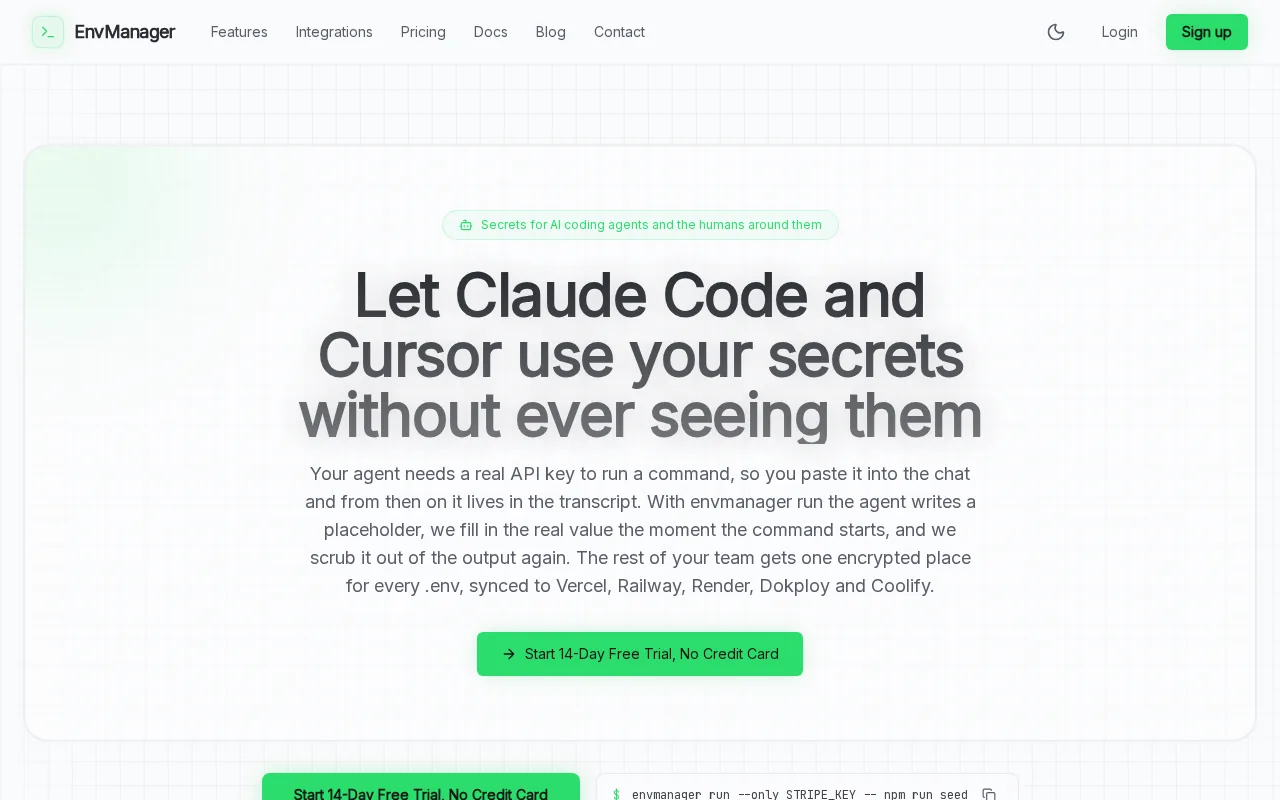
Small and mid-size engineering teams will get the most from EnvManager. You can keep one source of truth for development, testing, and deployment without asking a platform engineer to run a secret cluster.
We encrypt each value with AES-256 on import. RBAC, or role-based access control, lets you decide who can view or change secrets. The immutable audit trail records changes, which gives security teams a clear record during a review.
EnvManager also lists six CI/CD and deployment integrations: GitHub Actions, Vercel, Railway, Render, Dokploy, and Coolify. That covers many modern app stacks without forcing developers to copy values into each service by hand. You can also use the CLI to pull or inject variables during local work.
| Decision point | EnvManager fit | What to watch |
|---|---|---|
| Local .env workflow | Strong | Built around environment variables |
| Access control | Native RBAC | Set roles before wider rollout |
| Audit needs | Full audit trail | Review events during access changes |
| Rotation | — | No secret-rotation engine |
| Trial access | 14-day free trial | Test your full workflow first |
The trade-off is clear. EnvManager does not include dynamic secrets or an automated rotation engine. That makes it less suited to systems that need short-lived credentials issued on demand. For most env-var-focused teams, the lower operating burden is the better choice. Start with a test project and runenvmanager pull.
The Doppler pricing and alternatives breakdown gives useful cost context. EnvManager's flat-rate pricing for unlimited team members also makes it easier to estimate costs before committing. The key point is simple: EnvManager lets you test core workflows during a 14-day trial before committing.
2. Infisical, open-source flexibility with Doppler-style workflows
Infisical is a strong Doppler alternative for teams that want an open-source license and a self-hosting escape hatch. It suits developers who want a familiar secret workflow without giving up control of where the service runs.

Its free cloud tier covers up to five identities and three projects. That gives a small team room to test the basic workflow without an immediate bill. Teams can then compare the cloud path with self-hosting before they make a long-term choice.
Open-source software changes the cost equation, but it does not remove operational work. A self-hosted setup means your team owns updates, backups, access rules, and incident response. You also need to decide who will keep the service healthy when the primary maintainer is away.
Infisical makes sense when source access or deployment control is part of the requirement. It may be less appealing when your main goal is to remove infrastructure work. The free tier is also limited to five identities, so larger teams should test their expected access model early.
Compared with a closed SaaS product, the open-source path gives you more control over hosting and change management. Compared with EnvManager, it asks you to make a larger decision about ownership. The Infisical discussion of Vault alternatives also shows why teams often weigh self-hosting against a managed service.
Pick Infisical when self-hosting is a real requirement, not a theoretical preference. Otherwise, a managed env-var tool may save your team more time.
3. HashiCorp Vault, deep control for enterprise platform teams
HashiCorp Vault is a Doppler alternative for large enterprises with complex infrastructure and dedicated security teams. It is built for teams that need more than static application secrets.

Vault gives platform teams deep control over policies, authentication, storage, and secret delivery. That control can support multi-environment systems where different services need different access rules. It also fits cases that need dynamic secrets, where credentials are created for a limited period instead of stored forever.
The cost is operations. A team running Vault must manage the cluster, storage backend, seal process, high availability, and policy model. Unsealing is part of the operating model, not a one-time setup task. Someone must also own upgrades and recovery drills.
That burden changes the buying decision. If you already have platform engineers and strict internal controls, Vault can match your needs. If developers mainly need secure .env syncing for local work and CI/CD, Vault may be too much system for the job.
Vault also requires a stronger migration plan than a simple file import. Map each environment first. Then assign policies by service. Once access works in a staging project, move production workloads in small groups.
Vault is the right pick when secret management is part of a wider internal platform. It is a poor fit when your team wants a quick replacement for scattered environment files.
4. AWS Secrets Manager, native management for AWS workloads
AWS Secrets Manager fits teams whose applications run mainly on AWS. As a Doppler alternative, it works best when AWS services already form the center of your deployment and access model.

The main benefit is tight alignment with AWS workloads. Your team can keep secrets near the services that consume them, then use AWS permissions to control access. That can reduce the number of systems involved in a production deployment.
The fit weakens when local development matters as much as production. Purpose-built developer CLIs often make it easier to load a complete environment on a laptop. AWS Secrets Manager can require more setup when developers work across local tools, preview deployments, and non-AWS services.
Cost also scales with the number of secrets. Count secrets by environment before you compare plans. A team with many small services can end up managing a large set of individual entries, even when each service has only a few values.
AWS Secrets Manager does not solve a non-AWS stack by itself. If your release flow includes Vercel, Railway, Render, or another deployment system, check the handoff before choosing it. You may need extra scripts or connectors.
Choose this option when AWS is your clear home base. Choose EnvManager when the same variables need to move smoothly between local machines and several deployment platforms.
5. 1Password, familiar team workflows with CLI-based environment secrets
1Password is a reasonable Doppler alternative for teams that already use it and have light secret-management needs. Its CLI gives developers a way to work with environment values from the terminal.

Familiarity is the main draw. If your team already knows the interface, onboarding may feel easier than adopting a dedicated secrets platform. The CLI can also fit scripts that need to fetch values during local development or a build task.
But 1Password remains a general-purpose password manager. Environment-variable workflows are added around that core rather than built as the main product model. That distinction matters when you need environment separation, release controls, or a clear deployment handoff.
Think about the daily workflow. A developer needs a value for a local service. A CI job needs the same value under a controlled identity. A manager needs a record of who changed it. If the tool makes each case feel like a different workaround, the team may outgrow it.
1Password works when your existing investment matters more than deep secret-platform features. It is less suited to teams that need a dedicated source of truth for many environments and deployment targets.
6. Akeyless, managed enterprise capabilities without operating Vault
Akeyless is a managed Doppler alternative for enterprises that want Vault-class capabilities without running Vault themselves. It targets teams with higher security and compliance needs than a basic environment-variable store can cover.

Its strongest fit is an organization that needs advanced controls but does not want to own the underlying cluster. A managed model can reduce the work tied to storage, availability, and service upkeep. Akeyless also lists dynamic secrets as a key feature, which matters when credentials should expire or change as part of a workflow.
This model shifts the work rather than removing every decision. Your team still needs to define identities, policies, approval paths, and service ownership. Security leaders should also confirm the controls and records required by their audits before migration.
Pricing is custom quoted and usage based. That means a serious evaluation needs a clear inventory of secret count, access volume, environments, and required features. Ask for a model that reflects production growth, not only a small proof of concept.
Akeyless is a better choice than self-managed Vault when infrastructure ownership is the main concern. It is a worse fit for a small team that mainly wants a simple .env workflow with predictable cost.
What to check before switching
The right Doppler alternative depends on the gap you are trying to fix. Start with the workflow, not the feature list.
- Local development: Can a developer load the right environment without copying secrets?
- CI/CD: Can your build system read values without storing another copy?
- Access: Can you separate developer, service, and production roles?
- Audit: Can you see who changed a value and when?
- Rotation: Does the product rotate secrets, or will another system handle it?
- Hosting: Do you want managed SaaS, self-hosting, or a mix?
- Cost: Does the pricing model match your team size and secret count?
FAQ
What is the best Doppler alternative?
EnvManager is the best Doppler alternative for teams centered on .env files, local development, and CI/CD syncing. It combines encryption, version control, RBAC, and a full audit trail in a low-ops workflow. Infisical fits teams that want open-source flexibility, while Vault and Akeyless fit more advanced enterprise cases.
Which Doppler alternative has a free tier?
Infisical has a free cloud tier for up to five identities and three projects, while EnvManager provides a 14-day free trial. Check the limits against your identity count before treating a free tier as a long-term plan.
Is Vault better than Doppler?
Vault is better than Doppler when your team needs deep policy control, dynamic secrets, and dedicated platform ownership. It is not automatically better for local development or simple environment syncing. Vault brings more operational work, including cluster management, storage, sealing, high availability, and policy administration.
What should I use instead of Doppler for AWS?
AWS Secrets Manager is the strongest fit when your applications and deployment systems are mainly inside AWS. It keeps production secret access close to AWS services and permissions. EnvManager may fit better when the same values must serve local developers, CI/CD, and several non-AWS deployment platforms.
Can I migrate from Doppler to another secrets manager?
Yes, but plan the move around consumers rather than files alone. Export and review each environment, map names to the destination, then test local access and CI/CD access separately. Rotate sensitive values after the cutover when possible. Keep the old system read-only until the new workflow passes a full deployment test.
Conclusion
Choose EnvManager if you want secure environment-variable syncing without running a secrets cluster. It gives teams encryption, RBAC, version control, and audit history in one approachable workflow. Start with a non-production project, import a small .env file, and test the local-to-CI/CD path during the 14-day trial.